
The Real Reason Your CRM Isn’t Converting: It Was Never a Build Problem
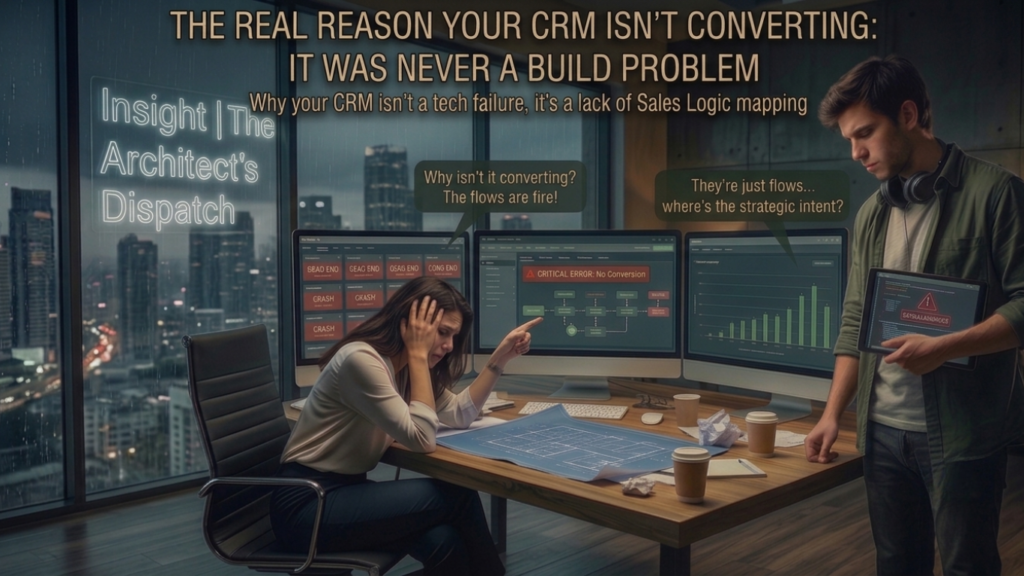
Every founder who hires someone to build their CRM is hiring for the wrong outcome, and most of them do not find out until the automations are live and nothing converts. I have sat inside enough of these systems to know the pattern by now. The workflows fire correctly. The triggers pull the right fields. The pipeline moves leads from stage to stage exactly as it was mapped to. And the business owner still calls me asking why none of it is working.
It is working. It was just never built to do the thing they actually needed.
The Pattern I Keep Seeing
I watched this exact problem play out for years before I ever touched a CRM, back when I was still deep in corporate real estate operations. It is not unique to systems work. Developers run into the same wall constantly. A founder builds a genuinely solid product, then cannot understand why the market is not responding. The product is not the issue. The go-to-market thinking behind the product was never built in from the start.
CRM builds fail the same way. A business owner hires someone who is skilled at building workflows, and that person builds exactly what they are asked to build. What almost never gets asked, by either side, is why the system should exist in the first place. Not the feature list. The intention. Who this needs to convert, what objection it needs to overcome at each stage, where the business actually loses people today. Skip that question and you get a system that runs beautifully and produces nothing, because the logic gate at every decision point was never designed around how the business actually sells.
Why This Confusion Persists
Here is where I think the real gap sits. Clients are trained to evaluate a builder on certification. Can they build in GoHighLevel. Do they know Zoho’s module logic. Have they touched this integration before. Those are fair questions, but they answer a different one than the question that actually determines whether the system works.
You cannot ask a builder to also be a sales strategist. That is not a fair expectation, and most builders would tell you the same thing if you asked them directly. Plenty of technically excellent developers cannot market their own businesses, which should tell you something about how separate these two skills really are. Knowing how to construct a workflow and knowing what that workflow needs to accomplish commercially are not the same discipline, even though most service agreements bundle them as if they were.
What AI Actually Changed, and What It Didn’t
AI tools have made the mechanics of building more accessible than they have ever been. Someone patient enough to follow instructions and iterate with an AI model can now produce a workflow that technically fires, faster than most of us could have five years ago. That part of the job has been genuinely democratized.
What AI has not touched, and I do not think it will anytime soon, is the mapping. Knowing what the system should actually do for the specific business behind it. Knowing where the real bottleneck lives, because the business owner rarely names it correctly themselves. That comes from operational pattern recognition, the kind you only build by sitting inside enough businesses to recognize the shape of a problem before the client finishes describing it. A tool can help you construct the logic once you know what the logic needs to be. It cannot tell you what the logic needs to be.
This is exactly why the complaints I hear are becoming more specific, not less. Business owners telling me their build does not convert, does not resolve the issue it was meant to fix, and now their marketing sounds less intentional than before they automated anything. That last part matters. A templated build does not just fail to help. It can actively flatten a brand voice that used to sound like a person.
Two Different Jobs, One Invoice
Think about how this works in construction, because the analogy holds cleanly. You do not fund an architect’s fee and then expect a builder’s scope of work. You do not hire a contractor and expect them to also design the foundation from scratch. The architect maps the structure to the actual use of the building. The contractor executes that map with precision. Both are essential. Neither replaces the other. And critically, neither is paid the same, because they are not doing the same work.
CRM builds deserve the same distinction. The person who maps your operational foundation, the logic, the sequencing, the sales intention behind every automation, is doing a fundamentally different job than the person who codes it into the platform. If you budget for a builder and expect architect-level thinking, you have set the expectation, not the builder. That is not a criticism of anyone involved. It is just an honest look at where the mismatch usually starts.
What Join Me Virtual Builds Instead
I do not claim to be the strongest developer in the room, and I would rather tell you that upfront than let a certification badge do the talking. I partner with a developer for the technical execution when a build calls for deeper coding work. What I bring is eighteen years of operational experience, most of it inside real estate, spent learning how businesses actually lose and win deals long before I ever opened a CRM platform.
That is the lens I map every system through. Not what the platform can technically do, but what your operation actually needs it to do, and why. A system built on that foundation does not just function. It converts, because it was designed with the same sales intention a founder would bring to the conversation themselves.
If your CRM is technically working and still not producing the results you expected, the problem was likely never the build. It was what the build was mapped to solve.
Book a Strategic Alignment Call and let’s find out what your system was actually built to do.
To your structural integrity,
Judith Vasquez
Systems Partner & Strategic OBM | Join Me Virtual