
How to Build a Service Offer That Actually Scales With Your Business
The offer is the first system your business runs on, and most businesses never design it on purpose.
Every business has a CRM eventually. A website. A content plan. A team. What most businesses do not have, even the ones that look fully built out, is a service offer that was designed with the same rigor as everything downstream of it. The offer usually just happens. A rate gets picked because it felt safe. A package gets created because one client asked for something specific and it became the template for everyone after. Nobody sits down and asks what the offer is actually for, or how each piece of it should relate to the others.
This matters more than it looks like it should, because your offer is not separate from your systems. It is the logic your systems are built to serve. Your CRM pipeline exists to move a lead toward your offer. Your automations exist to support delivering on it. Your team’s daily work exists to fulfill it. When the offer itself is vague or structurally inconsistent, that confusion does not stay contained. It spreads into every system connected to it, and you end up with a technically sophisticated business running on a poorly defined promise.
What an unarchitected offer actually costs you
An offer built without intention tends to fail in a few predictable ways. Pricing that blends different types of work into one flat rate, so you are effectively paying senior strategy rates for basic execution, or execution rates for work that requires real judgment. Tiers with no clear boundary, so clients quietly expect more than what was scoped, and your team absorbs the difference in unpaid hours. A structure that made sense when the business was smaller, but never got revisited as the business grew past it.
None of these show up as one dramatic failure. They show up as a slow erosion of margin and clarity, the same way a poorly architected CRM leaks leads instead of losing them all at once.
A working example: how the tiers of Join Me Virtual were built
I want to walk through my own offer structure, not as a sales pitch, but as a demonstration of the thinking involved, because the logic matters more than the specific numbers.
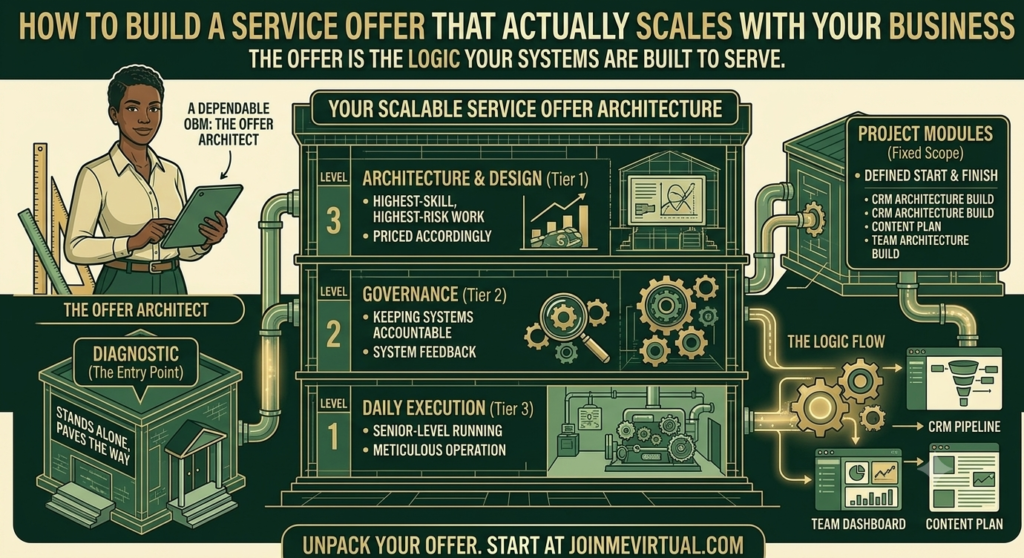
The diagnostic layer stands alone. Before any build happens, the diagnostic is priced and scoped as its own entry point. This exists because diagnosis and construction require different things from a client and from me. You should never pay build rates to find out what is actually broken, and you should never expect a diagnostic to include the fix. Keeping them separate keeps both honest.
Project Modules are fixed-scope, one-time investments. A CRM architecture build, a conversion funnel, a real estate-specific automation kit, each of these has a defined start and finish. Pricing them as flat, one-time projects instead of open-ended hourly work protects the client from scope creep and protects the quality of the build, because the full outcome is defined before work begins.
The ongoing retainer splits into three tiers, not one. This is the piece most service providers skip. Instead of one hourly rate that tries to cover strategy, governance, and daily execution all at once, the work is separated by function. Tier 1 covers ongoing architecture and design, the highest-skill, highest-risk work, priced accordingly. Tier 2 covers governance, keeping an already-built system accountable without redesigning it. Tier 3 covers daily execution, the meticulous, senior-level running of a system that is already sound. Each tier is priced to reflect what it actually requires, not blended into a single number that overpays for some work and underpays for other.
The result is an offer where a client always knows exactly what they are paying for and why, and where the pricing itself tells the truth about the risk and skill involved in each layer of work.
Why this requires more than technical skill
Here is the distinction that matters most. A technically capable VA or junior systems builder can tell you whether an automation fired correctly. They generally cannot tell you whether your pricing structure is quietly undercharging for your highest-skill work, or whether your tier boundaries are vague enough to be inviting scope creep every month. That kind of feedback requires someone who has operated inside pricing and offer design directly, not just inside the software.
This is the difference between hiring someone to execute inside your systems and hiring a right-hand partner who can evaluate the business model those systems are built to support. A right-hand partner without this experience can flag a broken workflow. They cannot tell you that the workflow is fine and the offer sitting on top of it is the actual problem. That distinction is often the difference between a business that fixes a symptom and a business that fixes the cause.
Why the website matters just as much as the builds
The same logic applies to how an offer gets communicated. A well-priced, well-structured service ladder still fails if the copy around it is vague, generic, or structurally confusing to the person reading it. The website is not just a functional container for your offer. It is where the pricing strategy either gets translated clearly, or gets lost in language that could describe any business. Copy and pricing are not two separate projects. They are two expressions of the same underlying architecture.
If your service offer feels unclear, even to you, that is worth a closer look before anything else gets built on top of it.
This is the exact judgment a right-hand partner needs to bring to the table, not just whether a workflow runs, but whether the offer sitting on top of it actually holds up. Spotting that is part of what Tier 2: Strategic OBM and Systems Governance is built for. I stay close enough to both the system and the business model behind it to flag exactly this kind of gap before it quietly costs you. If what gets flagged turns out to need a rebuild, that becomes a Tier 1 architecture engagement or a standalone Project Module, scoped and priced for what it actually is. Governance tells you what’s wrong. Architecture is what fixes it.
Learn more about Tier 2 by clicking the button below, and let’s look at what your offer architecture is actually telling you.
To your structural integrity,
Judith Vasquez
Systems Partner & Strategic OBM | Join Me Virtual