
The Cost of the Fast Fix
What you think is saving you rather than what it truly costs you, or builds that focus on execution not revenue.
Business right now is rewriting its own rules faster than most founders can keep up with, and I understand exactly why that feels like a threat to fall behind rather than a decision to make with a clear head. The pressure is not coming from nowhere. It is coming from a market flooded with people positioning themselves as experts on tools that did not exist eighteen months ago.
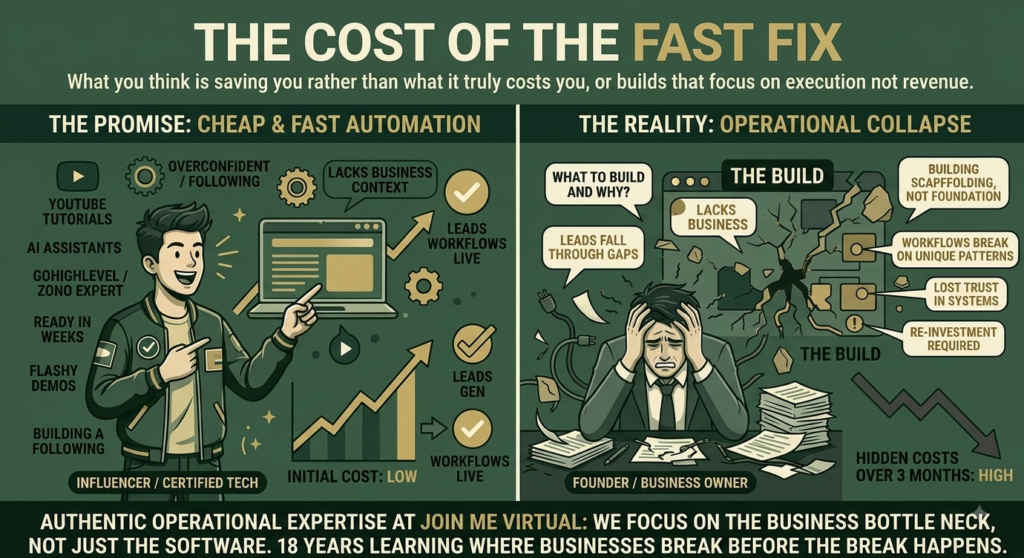
So ask the question that actually matters before you hand your business to any of them. How long has this person been doing this. Because pulling a trigger inside GoHighLevel or Zoho is something anyone can learn from a YouTube tutorial and an AI assistant in a matter of weeks. I know that firsthand. I learned the tools themselves quickly, and I will not pretend otherwise. What I did not learn in weeks, and what cannot be learned in weeks, is the instinct for what to build and why. That instinct comes from years spent inside real operations, watching where they actually break.
A certification tells you someone can operate the software. It does not tell you they understand your business. The same automation logic that runs beautifully for an HVAC company will not necessarily serve a real estate team, because the bottleneck is never the software. It is the specific way your business moves, and that takes real operational time to see clearly. Someone can build a system that fires every trigger perfectly and still hand you something that was never built with your business in mind.
I am not here to tell you I am the best at tools. At Join Me Virtual, I do not promise that. What I promise is a build that solves the actual bottleneck in your business, because I have spent eighteen years learning to see where businesses break before the break happens. That is a different offer than most of what is circulating right now, and I think founders deserve to know the difference.
Because here is the part that does not get said enough. Building a following is not the same as being an expert. Some of the loudest voices teaching automation right now are good at one thing, and it is not operations. It is selling. Their real business is the course, not the client outcome, and the volume of their content is not evidence of the depth of their understanding. That is exactly why founders need to get sharper about investigating who they bring in. A real track record. Real time spent handling operations, not just time spent online. That is what tells you whether someone can actually resonate with what your business needs, or whether they just know how to make the pitch sound good.
Here is what I have watched happen instead, more times than I can count. A founder picks the option that looks cheapest or fastest to launch. Someone shows them how to automate a sequence, connect a workflow, wire up a follow-up. It works, for a while. Then a lead falls through a gap nobody mapped. A workflow breaks the moment the business does something slightly outside the pattern it was built for. The founder is back where they started, except now they have also lost the time, the trust in systems generally, and often the money they thought they were saving.
I have sat across from founders at exactly this point more times than I can count. Not people who made a careless decision. People who made a reasonable one, based on the information they had at the time, and got let down by someone who never should have been trusted with the build in the first place. The gap is rarely dramatic when it first appears. It shows up as a lead that went quiet for no clear reason, a follow-up sequence that fired at the wrong moment, a report that never quite matched what actually happened in the pipeline. Small things, easy to dismiss individually. Together, they are the sound of a system that was never built to hold the business it was handed.
There is a real difference between someone who knows how to automate and someone who understands the business well enough to know what should be automated, in what order, and why. The first person can make a workflow run. The second person builds something that holds when the business changes shape around it, because it was built on an understanding of how the business actually operates, not just on what the software can technically do. That difference does not show up on day one. It shows up three months in, when the cheap and fast version starts costing far more than the foundation would have.
This is the part that is hard to see in advance, and it is the part I have spent almost two decades learning to see early. A system built without operational grounding is not really a system. It is scaffolding dressed up to look permanent. It will hold weight for a while. It was never built to hold the business as it grows, because the person who built it was solving for automation, not for the business underneath it.
I think about this the same way I think about a building. Scaffolding can look almost identical to a finished structure from a distance. It can even hold weight for a while, long enough that nobody questions it until the wrong load gets placed on it at the wrong moment. A foundation is different. Nobody sees it once the building is standing, but everything above it depends on decisions made before the first visible piece went up. Most of the operational work that actually protects a business happens in exactly that invisible layer, in the decisions about sequence, ownership, and logic that a founder never sees unless something goes wrong.
My role is not to sell you on the idea that automation is the answer. It often is not, not on its own. My role is to help you ask a better question before you commit to anything: does this person understand my business well enough to build something that will still be standing in a year, or are they just showing me what the software can do?
That question is worth more than any comparison chart. It is the difference between building a foundation and renting scaffolding you will have to replace. And it is also, honestly, why I have made a point throughout my own career of being direct about what I do and do not claim. I am not the flashiest name in this space, and I have never wanted to be. I would rather be the person a founder calls after they have already been burned once, because by then they already know what actually matters.
If you are standing where a lot of founders stand right now, surrounded by options and no clearer than when you started, that is not a sign you are behind. It is a sign you are being careful with something that matters. The next step is not another tool. It is a conversation with someone who has handled the operations long enough to know exactly what to look for underneath your business before recommending anything at all.
Book a Strategic Alignment Call and let’s look at what is actually happening underneath your operations before anything gets built.
To your structural integrity,
Judith Vasquez
Systems Partner & Strategic OBM | Join Me Virtual