
The Silent Leak: Why High-Converting Funnels Still Bleed Revenue
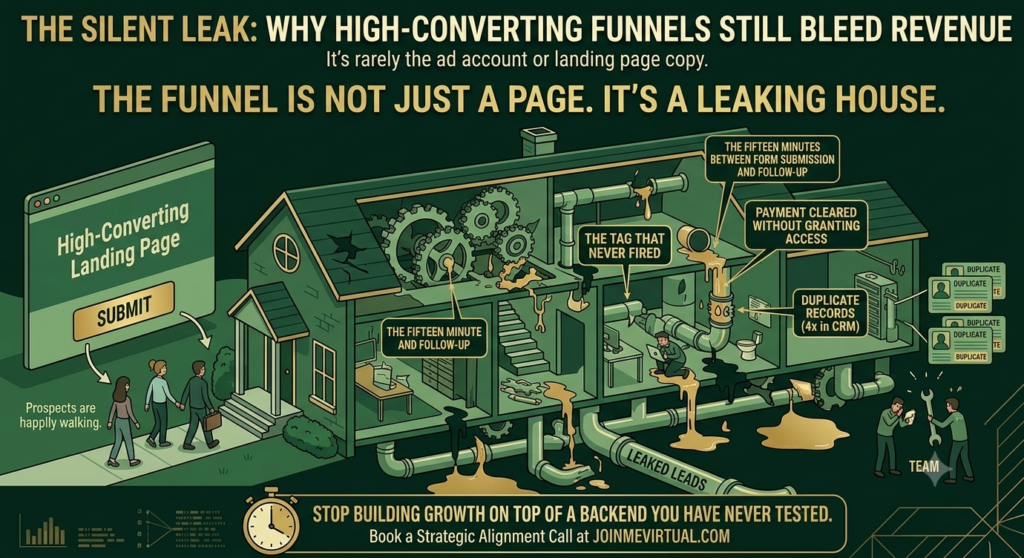
I have audited enough funnels to know the ad account is rarely the problem. The landing page converts fine. The copy does its job. What breaks is everything the prospect never sees: the fifteen minutes between form submission and follow-up, the tag that never fired, the payment that cleared without granting access to what they just paid for.
Founders keep treating the funnel as the front door. It is the whole house. And most of the rooms nobody has checked in months.
This matters more than most people realize, because the instinct when conversion rates disappoint is almost always the same. Rewrite the headline. Test a new ad. Spend more to drive more traffic through a door that was never the issue. Meanwhile the actual leak sits further back, in the part of the business nobody thinks to open the hood on.
The Clock Starts the Moment They Submit
Every form fill is a countdown. The prospect is interested right now, not whenever your team gets to the inbox. If the system depends on someone manually distributing leads, batching emails, or checking a webhook by hand, the interest cools with every minute that passes.
I have seen real estate teams lose qualified buyers not because the listing wasn’t right, but because the inquiry sat unrouted for two hours while the agent was in a showing. The lead didn’t go cold from bad marketing. It went cold from bad plumbing.
This is where speed-to-lead architecture earns its keep. Not as a buzzword, but as a structural decision about how your business behaves in the moments that determine whether a prospect feels chosen or forgotten. An automated confirmation, an instant calendar link, a qualification sequence that starts the second someone raises their hand. None of it needs to be flashy. It needs to close the gap between interest and response before that interest has time to fade.
An engine that runs well closes that gap automatically. Not because speed impresses people, but because speed is what tells them someone is actually there.
Data Has to Move Once, Correctly, or It Doesn’t Count
A funnel is only as strong as its weakest connection point. When a lead opts in, books a call, or makes a deposit, that information has to land in one place without a human retyping it, reformatting it, or manually deciding where it belongs.
I have walked into more than one CRM where the same contact existed four times under four slightly different tags, each one triggering its own outreach sequence. Nobody built that on purpose. It accumulated, integration by integration, quote by quote, until the system was quietly working against the people running it.
This is the part of CRM architecture that never makes it into a sales page but decides whether the whole operation holds together. Broken webhook payloads that silently drop order notifications. Payment gateways that process a charge but never trigger portal access. Duplicate records that cause the same prospect to receive three different versions of the same email in one afternoon. None of these show up in your conversion rate. All of them show up in your reputation.
An engine does not tolerate duplication. Data enters once, gets classified correctly, and triggers exactly the workflow it should. Anything less isn’t automation. It is a manual process wearing automation’s clothes, and it costs exactly as much time as the manual version did, just less visibly.
The System Has to Know What It Already Knows
Nothing erodes trust faster than a client getting a promotional email for something they already bought, or an abandoned cart reminder ten minutes after they finished checking out. It tells them, in the clearest way possible, that nobody is actually watching.
A well-built engine checks itself before it speaks. It knows who has already booked, who has already paid, who has already moved past the offer being pitched. That contact gets routed into onboarding, not back into the funnel they just exited. The logic gate that prevents this is not complicated to build. It is simply almost never built, because it does not show up as urgent until the day it embarrasses you in front of a client who was ready to become a referral source.
This is not a minor technical detail. It is the difference between a system that represents you well when you are not in the room and one that quietly undermines the trust you spent months building to get that person to say yes in the first place.
The Engine Doesn’t Stop at Checkout
Most founders spend ninety percent of their attention on the page before the sale and almost none on what happens after the card clears. Then a launch goes well, volume spikes, and the backend that was never built for that kind of weight starts dropping things: access links that don’t send, support inboxes that flood, records that don’t update fast enough to keep operations honest.
The purchase is the middle of the process, not the end of it. An engine built with real structural integrity delivers access, updates the client record, and alerts the right person on the team, all without the founder standing in the gap doing it by hand at eleven at night because the automation only worked for the first fifty orders.
This is the part I get called in for most. Not because the front end failed, but because everything behind it was never built to hold the weight of the business it has since grown into.
What Actually Makes a Funnel Structurally Sound
Building a funnel that scales requires more than stringing together disparate marketing tools or applying a patch every time something breaks. It requires operational logic, the kind that treats the business as a system with dependencies, not a collection of separate tools that happen to be connected.
Eighteen years of operational work, most of it inside real estate, taught me that a funnel is not a page. It is a machine with moving parts, and machines fail at their weakest connection, not their most visible one. A high-converting landing page sitting on top of a fragile backend is not a growth engine. It is a liability waiting for enough traffic to expose it.
When I build a system for a client, whether the architecture runs through GoHighLevel or Zoho, I am not decorating the front end. I am checking every joint in the engine: where data hands off, where logic gates sit, where the process could quietly break under pressure nobody has tested yet. That is the work that actually protects revenue, and it is almost never the work founders think to ask for until they have already felt the cost of not having it.
Where the Leak Actually Is
If your funnel is converting on paper but still costing you leads somewhere between the click and the close, the leak is almost never where you’re looking. It is not in the ad copy. It is not in the landing page design. It is in the fifteen minutes after the form submits, in the tag that fires twice, in the access link that never sent.
Stop building revenue growth on top of a backend you have never actually tested under pressure. A funnel is a machine, and machines deserve to be inspected by someone who knows exactly where they tend to fail.
Book a 30-minute Strategic Alignment Call at joinmevirtual.com, and let’s find out where your engine is actually losing power.
To your structural integrity,
Judith Vasquez
Systems Partner & Strategic OBM | Join Me Virtual