
I Built a “PropTech Command Center” from Scratch (Part 2: The Zoho Backend)
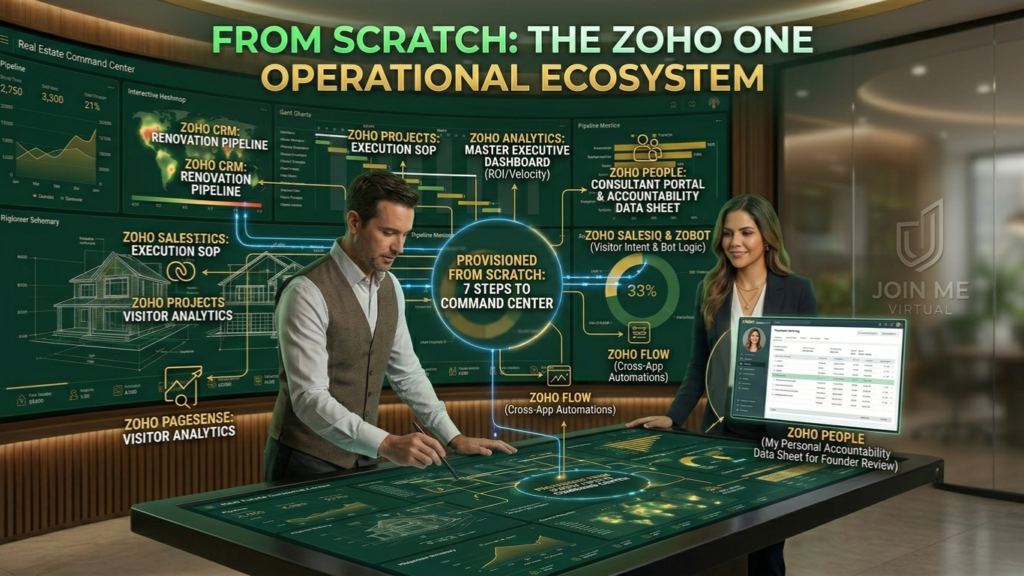
In the high-stakes world of PropTech and real estate renovation, speed is currency and data chaos is the ultimate profit killer.
When you are managing properties, tracking renovations, and fielding incoming leads simultaneously, you cannot afford to have data scattered across spreadsheets, text messages, and disconnected apps. If your frontend marketing engines are pushing out dozens of leads a day, but your backend looks like a chaotic digital junk drawer, you aren’t scaling. You are simply losing opportunities faster.
Before I stepped in, a fast-growing PropTech startup specializing in real estate renovation faced a critical operational bottleneck. The business had no unified “central brain.” Leads were disorganized, tracking the productivity of agents was nearly impossible, and there was no systemized way to follow a prospect from their initial inquiry down to the final signed contract.
To solve this, I architected and implemented an end-to-end, corporate-grade backend infrastructure using Zoho One.
Whether you are currently struggling with an unruly database or trying to decide which platform to trust with your business operations, this deep dive breaks down the exact architectural steps I took, along with a raw, validated comparison of how enterprise ecosystems actually perform in the real world.
The Strategic Reality Check: Zoho One vs. GoHighLevel (GHL)
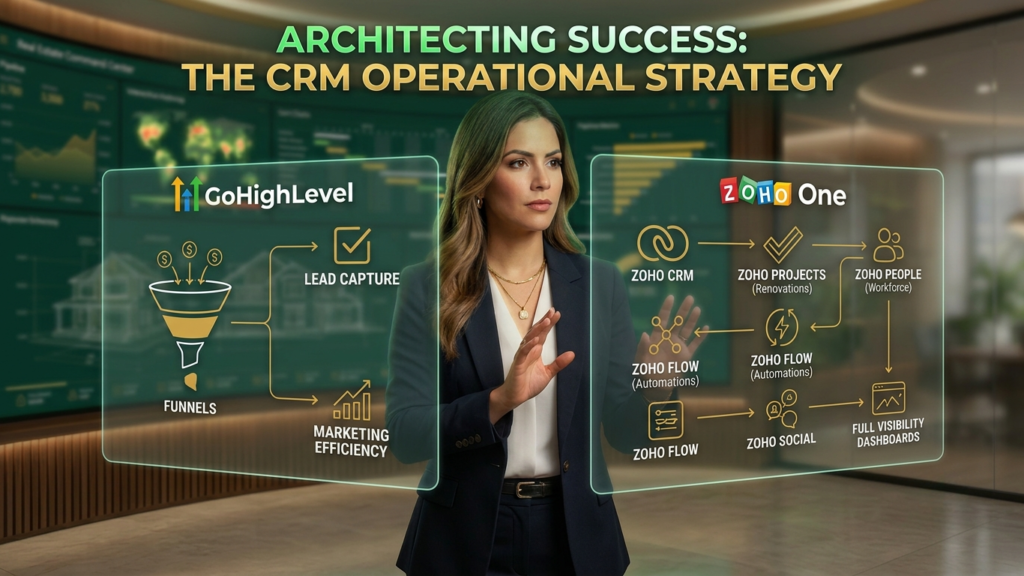
When a business reaches the point where it needs a robust digital infrastructure, the decision usually comes down to two major platforms: Zoho and GoHighLevel. Both are powerful, but they serve completely different operational philosophies.
Based on my professional hands-on experience deploying these tools, here is the honest, unfiltered truth about how they stack up.
The Setup and Technical Complexity
Let’s be completely transparent: Zoho is significantly more complicated to set up than GoHighLevel. GoHighLevel is built for quick wins, offering an intuitive, visual sandbox where you can launch a funnel and an automated sequence in an afternoon.
Zoho, conversely, requires a strict, methodical approach to data logic, schema creation, and field mapping. It is built with enterprise rules in mind. If you do not map out your processes correctly from day one, it can easily turn into a digital labyrinth. However, if you invest the time to build it properly, it gives you an unbreakable foundation that can support a multi-million dollar operation.
The Email Marketing Structure
If your primary operational goal is massive, flexible marketing broadcasts and simple lead nurturing, GoHighLevel is undeniably more generous. GHL treats contact limits and marketing features with an all-inclusive, agency-first mindset.
Zoho’s native email marketing features can feel rigid and highly restrictive if you try to treat it as a basic marketing broadcast tool. Zoho demands strict compliance, clean list hygiene, and highly structured subscriber segmentations.
The Enterprise Verdict and Project Management Gaps
So why choose Zoho over GoHighLevel for a complex real estate renovation company? Because Zoho is designed for comprehensive, multi-department corporate infrastructure. Where GoHighLevel’s capabilities stop, Zoho thrives. A real estate renovation business isn’t just about capturing a lead; it is about executing a physical, multi-step project once that lead converts. GoHighLevel completely lacks native, robust project management tools. Zoho allows you to seamlessly bridge the gap between marketing, sales, client onboarding, human resources, and field operations under a single, unified enterprise subscription.
The Blueprint: Step-by-Step Architecture of the PropTech Command Center
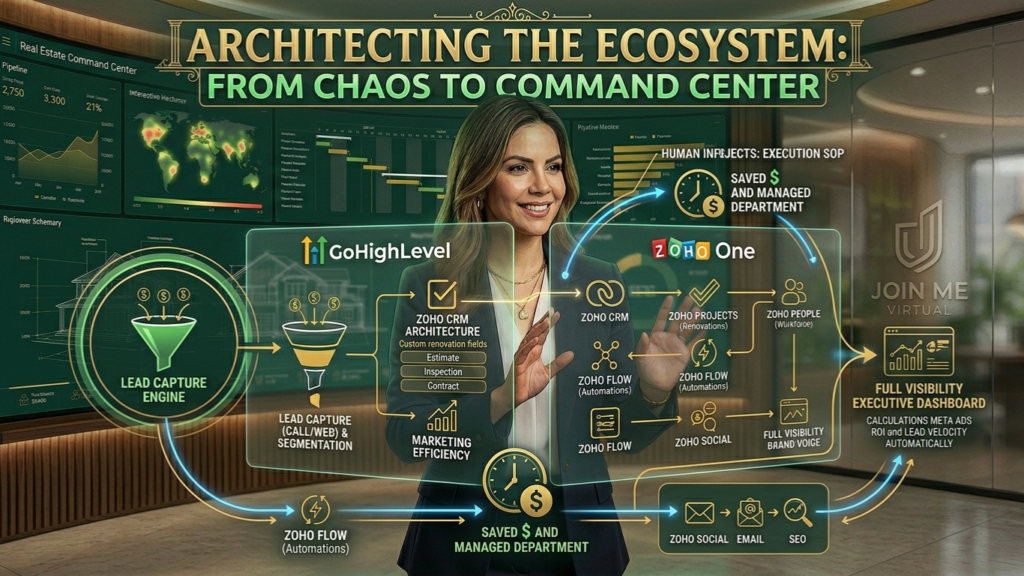
To build true operational accountability for this client, we didn’t just purchase standard CRM software. We deployed Zoho One (Zoho’s comprehensive business operating system) and deliberately stitched its standalone applications together into an airtight, closed-loop pipeline.
Here is the exact step-by-step breakdown of how the architecture functions.
Step 1: Mapping the Custom Lead-to-Contract Pipeline (Zoho CRM)
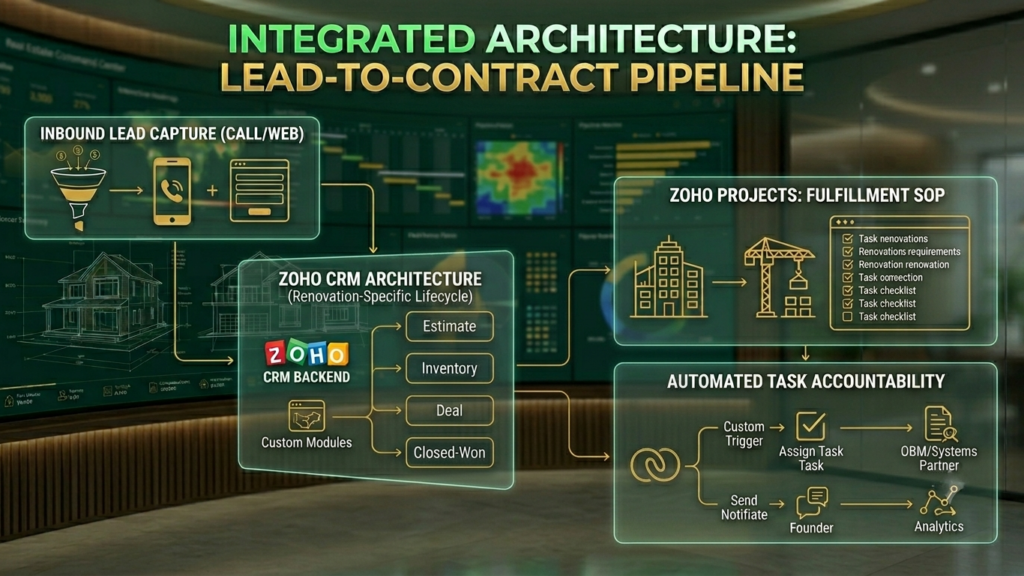
A standard, out-of-the-box pipeline layout does not work for the high-velocity, milestone-heavy nature of real estate renovation projects. The lifecycle of these leads is incredibly specific, requiring distinct handoffs between estimation, property inspection, and contract drafting.
I performed a full, end-to-end Zoho CRM implementation customized specifically for this renovation lifecycle. We engineered clear pipeline stages so that the moment a lead entered the ecosystem, the entire team knew its exact status. This visibility allowed management to track the precise progression of deals from initial interest straight through to a closed contract.
Step 2: Eliminating Data Chaos with Automation (Zoho Flow)
When call and web engines are running at scale, data can get messy very quickly. To bridge our frontend communication channels directly to our backend without human error or manual entry, we deployed Zoho Flow (Zoho’s native enterprise alternative to Zapier or Make).
Zoho Flow listened for webhooks from our outreach systems and pushed data cleanly into the CRM in real time. Every incoming lead was instantly tagged by geographic market, renovation type, and intent level. This strict automation kept the main database immaculate, structured, and instantly actionable for long-term nurturing sequences.
Step 3: Aligning Brand Message with Inbound Interest (Zoho Social)
To ensure the marketing frontend stayed fed with fresh interest, we integrated Zoho Social. Rather than using detached social media scheduling tools, Zoho Social brought all social management under the central brain.
This allowed us to schedule real estate project showcases, manage brand interactions across multiple platforms, and track exactly how social engagement correlated with inbound lead spikes inside the CRM. Marketing and sales finally spoke the same language.
Step 4: Triggering Real-World Execution (Zoho Projects)
This step is where Zoho completely separates itself from standard marketing tools. A business cannot survive on sales alone; those sales must be fulfilled efficiently.
The moment a deal shifted to a specific pipeline stage within Zoho CRM, an automated workflow instantly triggered the creation of a corresponding client renovation project inside Zoho Projects.
Specific operational milestones were generated, timelines were locked in, tasks were automatically assigned to me as the Systems Partner/OBM, and instant notifications were pushed to the founder. No manual emails, no forgotten handoffs, and 0% lead slippage.
Step 5: Tracking Live Visitor Intent (Zoho SalesIQ, Zobot, and Zoho PageSense)
Understanding user behavior on your digital assets is crucial to maximizing marketing investments. We embedded Zoho SalesIQ directly onto the web platforms to track live visitor engagement, monitor traffic patterns, and provide intelligent chat routing for active prospects.
To maximize this traffic, we deployed Zobot (Zoho’s native AI conversational bot engine) within SalesIQ to engage prospects instantly. Zobot handled initial multi-choice screening queries from visitors, qualification metrics, and lead capture around the clock. High-intent renovation prospects were then automatically routed directly to active team members for immediate human intervention.
Simultaneously, we deployed Zoho PageSense to run detailed form analytics and website heatmaps. By watching exactly how potential clients interacted with our digital landing pages, we could see precisely where users got confused or abandoned the renovation intake forms, allowing us to optimize the user journey based on actual behavior.
Step 6: Engineering Absolute Partner Accountability (Zoho People)
To ensure complete transparency between myself and the founder, we utilized Zoho People as a dedicated consultant management portal. Rather than using disorganized, external timesheets, I integrated my personal tracking metrics directly into the system.
This environment serves as a clean, structured data sheet where the client can log in at any moment to review exactly what high-level architecture tasks I have executed. By recording exact time investments against active system improvements, it gives the founder absolute visibility into operational progress and provides verified data that justifies every dollar spent on premium management.
Step 7: Consolidating the Master Dashboard (Zoho Analytics)
The final step was establishing complete executive transparency. We pulled data from PageSense, digital ad channels, operational workforce metrics, and the CRM backend, funneling it directly into Zoho Analytics.
This created a centralized, single source of truth for the company leadership. The founder went from guessing which marketing channels or team members were driving actual revenue to seeing true marketing ROI, lead velocity, and operational performance calculated automatically in real time.
The Operational Impact: Institutional Efficiency on a Lean Budget
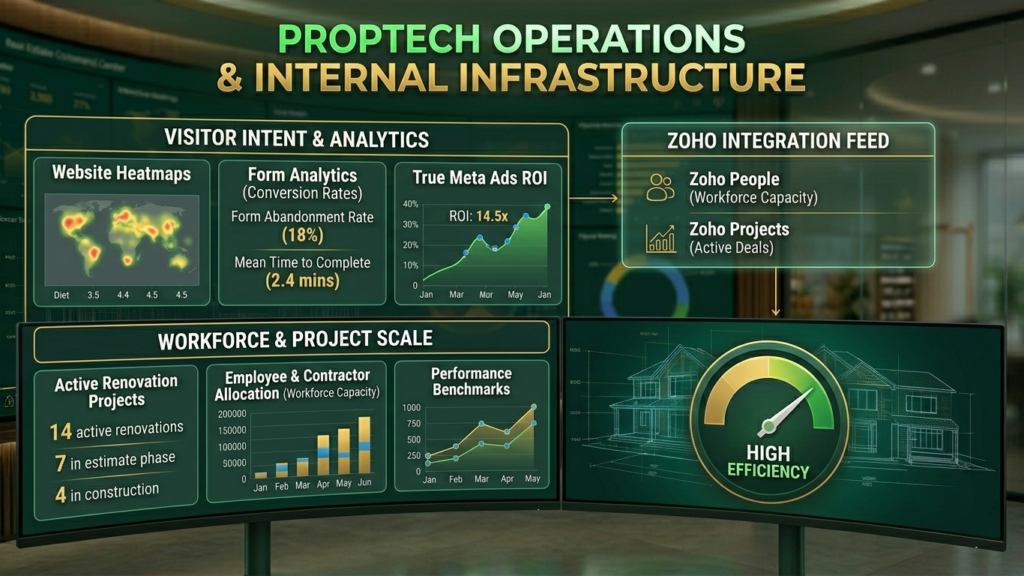
By combining clean frontend logic with a deeply integrated Zoho One backend, we built an enterprise-grade command center that delivered a fully systemized infrastructure at a fraction of the cost of traditional, fragmented software stacks. The company moved away from operational chaos and stepped into a model of total accountability.
If your current business operations feel like a puzzle with missing pieces, you do not need to spend months struggling with webhooks, database logic, or pipeline configurations on your own. I have already designed, built, and proven this exact architectural framework.
I can install these structural systems into your business faster than you can learn them.
If you are ready to stop guessing and start scaling with true structural integrity, let’s build your command center together. Visit Join Me Virtual today!
To your structural integrity,
Judith Vasquez
Systems Partner & Strategic OBM | Join Me Virtual