
Navigating the AI Noise: A Practical Guide to Chat GPT, Gemini, and Claude.
Starting with AI right now can feel incredibly overwhelming. With the explosion of new tools, options, and features dropping every single week, the landscape is much louder than it was two or three years ago. If you are feeling confused about where to begin or which tool actually fits your workflow, you are not alone.
Social media is full of noise. Content creators often try to make AI look highly complicated or intimidating, sometimes just to sell you an expensive course or service. But the truth is simple: the most powerful tool is already sitting right in front of you. The best way to learn AI is to start using it, practicing with it, observing how it reacts, and discovering how to prompt it effectively through real-world trial and error.
Everyone has a different level of technical knowledge. This breakdown is not to insist that one tool is universally superior, but to share my personal verdict based on my day-to-day workflow. Personally, I am deliberately choosing to use free AI tools for now. With so many competing features constantly being added across these different platforms, I am still evaluating what the best tool is to officially finalize. I want to wait for the option that will truly give me the most value for money. My goal here is to set realistic expectations and save you hours of unnecessary frustration.
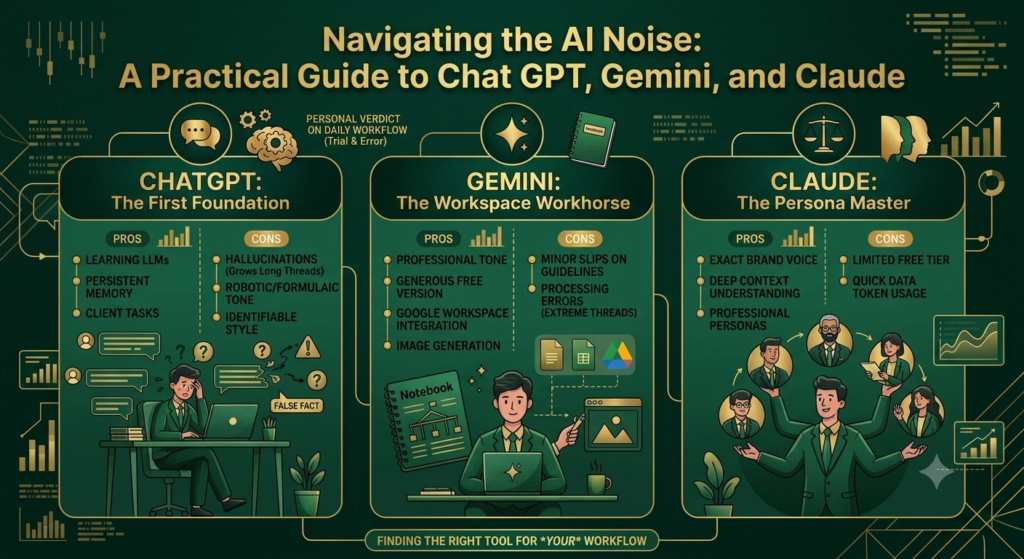
My First Foundation: Chat GPT
When I began my AI journey, Chat GPT was my fundamental starting point. It was the space where I learned what large language models could do, understood their nuances, and tested our professional compatibility. Like anyone else, I felt intimidated at first, but it quickly became an asset for breaking down complex client tasks.
One of Chat GPT’s strongest features is its ability to hold a persistent memory across a conversation. However, as your chat threads grow exceptionally long, a major limitation appears: it starts to hallucinate, give incorrect answers, or forget earlier instructions. You have to remain incredibly sharp to spot when the model begins losing its grip on the details.
Over time, I completely stopped using Chat GPT. The execution began to sound overly robotic, repetitive, and plagued by predictable linguistic patterns. Because it is the most widely recognized AI, its writing style has become instantly identifiable to the public. In marketing, copy, and operations, we want to remain intentional, authentic, and locked into our own unique voice. That realization is what forced me to look elsewhere.
The Workspace Workhorse: Gemini
My search for a more natural voice led me to Gemini. Initially, I thought Gemini struggled because it didn’t seem to retain memory during standard chat sessions. However, I discovered that utilizing its specialized Notebook feature solves this memory problem entirely. While it can still occasionally slip up on minor details even after being given strict guidelines, its strengths far outweigh these small hiccups.
What I love about Gemini is its tone. The language feels highly professional, elevated, and far less formulaic than Chat GPT. Furthermore, its free version is incredibly generous, accommodating long prompts and continuous work without abruptly cutting you off or forcing a multi-hour cooldown.
The integration of Gemini into the Google Workspace ecosystem makes it exceptionally fast and efficient for handling research. It also offers much more flexible image generation capabilities compared to its competitors. It is worth noting that on extremely long, continuous threads, Gemini can sometimes encounter processing errors, but as a robust, everyday engine, it is highly dependable.
The Persona Master: Claude
The newest addition to my active toolkit is Anthropic’s Claude. When it comes to capturing an exact brand voice, understanding deep context, and maintaining conversational integrity, Claude is truly exceptional. It excels at adopting specific professional personas without sounding artificial.
My only real constraint with Claude is the limitation of the free tier. Because its advanced reasoning consumes a high volume of data tokens, the free version can cut you off quickly once your usage limit is reached.
When my Claude usage resets or gets interrupted, I seamlessly pivot back to Gemini. Today, my operational strategy relies on a deliberate tag-team approach between Claude and Gemini. A fantastic technique you can use in your own work is to feed the same prompt to both platforms, compare their distinct styles, and choose the output that best serves your specific goals.
The Realistic Reality: The Pros and Cons of AI
While AI tools are revolutionary, we must look at them with a balanced perspective.
The advantages are undeniable. AI is an incredible supplement for accelerating research, brainstorming alternative marketing angles, uncovering hidden inefficiencies, and beautifying your final drafts. It acts as a highly capable co-pilot that expands your creative and analytical horizons.
The disadvantages, however, can be dangerous if ignored. AI is fundamentally probabilistic, not deterministic. It does not truly “know” facts; it predicts the next most logical word. This means it can confidently present false data as absolute truth. If you allow AI to make final decisions without micro-managing the nitty-gritty details, it will eventually lead to massive, costly business errors.
Debunking the Myth: Will AI Replace Your Job?
There is a widespread fear that AI is going to completely replace human professionals. Based on my experience in high-level operations, I do not believe AI will totally replace people.
Instead, the reality is much more nuanced: professionals who master AI will inevitably replace those who refuse to adapt.
AI cannot replicate genuine human intuition, strategic foresight, or deep emotional empathy. However, a person who understands how to steer an AI, build structured prompts, and audit machine outputs will move five times faster and provide far more value than someone relying entirely on manual, legacy methods. The competitive advantage belongs to those who view AI as an enhancement, not a threat.
A Serious Warning for Business Owners and Clients
I want to issue a direct call-out to business founders, leaders, and clients: simply purchasing an AI tool or turning on an AI feature will not magically solve your operational problems, especially when it comes to business automation.
Many leaders fall into the trap of thinking that because an AI node exists, their workflows will automatically become seamless. This is a dangerous misconception for three specific reasons:
- AI lacks structural logic. An AI can draft a beautiful email, but it cannot map out the conditional backend architecture required to sync your CRM, manage webhook triggers, handle rate limits, or secure database access keys.
- A bad process automated with AI just becomes a faster bad process. If your underlying business workflow is disorganized, chaotic, or fundamentally broken, adding AI will only accelerate the chaos and alienate your customers at scale.
- Human oversight is the ultimate bottleneck. Tech stacks require constant human-in-the-loop validation. Without a skilled strategic partner to configure the logic gates, monitor data plumbing, and build strict behavioral guardrails, your automated AI systems will eventually hallucinate and cause structural breakdown.
The Brain Behind the Machine: Join Me Virtual
At the end of the day, you must remember that you are the brain. AI is simply the engine. The core knowledge, the strategic direction, and the quality of the inputs must come directly from a human expert. We use AI to supplement and optimize, but the final verdict always rests on human shoulders.
Building a business infrastructure that scales requires more than just subscribing to Chat GPT, Gemini, or Claude. It requires a deep understanding of operational logic and digital architecture.
If you are ready to stop guessing with disorganized tools, plug the operational leaks in your business, and transition from manual exhaustion to pure structural integrity, let us connect. At Join Me Virtual, I help scaling leaders build secure, automated conversion engines and repeatable protocols that actually protect your peace of mind. Let us build an automated engine that sets you free.
P.S. I actually used Gemini to draft my final article based on my ideas. I’m impressed by how perfectly it captured what I wanted to say without any hesitation—it honestly feels like the tool has learned my writing style over time. Give it a shot and tell me what you think! Which AI tools are in your current tech stack?
To your structural integrity,
Judith Vasquez
Systems Partner & Strategic OBM | Join Me Virtual