
What Building a Business Actually Teaches You (And Why It Doesn’t Get Easy at First)
Why the early years cost more than you planned, and why that’s not a sign you’re doing it wrong.
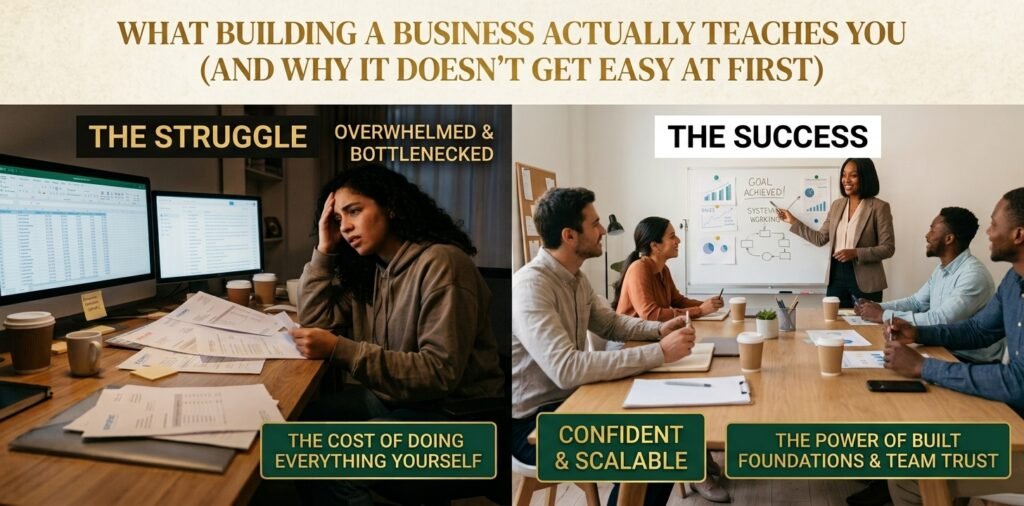
Every business I have built, for myself or for a client, started with the same uncomfortable fact: nothing gets easier before it gets more expensive. Not in money alone. In time, in energy, in the quiet cost of doing something for the first time without a map. Eighteen years in operations taught me that the founders who make it are not the ones who avoided this stage. They are the ones who stopped expecting to skip it.
If you are in the early years of building something, here is what I have learned, watching this pattern repeat across real estate teams, service founders, and my own two businesses.
1. You Have to Spend Before You Can Build
There is a persistent myth that a reputable business can be built for free, that a website and a social presence just require your own two hands and enough evenings. Technically, that is true. Practically, it is one of the most expensive decisions a founder makes, because the cost shows up as time instead of money, and time is the one resource you cannot recover.
Building it yourself is not free. It is a trade. Every hour spent learning a platform, fixing a broken template, or second-guessing your own copy is an hour not spent on the work that actually generates revenue. Spending early, whether on tools, on expertise, or on the right foundation, is not a shortcut. It is what makes the build possible at all.
2. Trial and Error Is the Actual Curriculum
No one tells you this part clearly enough: some of your worst setbacks will come from decisions that looked correct at the time. You hire your first staff member to lighten the load, and for a stretch, the load gets heavier, because now you are managing a person instead of just the work. That is not a sign you made a mistake. That is the learning curve doing exactly what a learning curve does.
The founders who recover fastest from this are not the ones who avoided hiring wrong or building wrong. They are the ones who treated it as tuition rather than failure, and adjusted the system instead of abandoning it.
3. The Timeline You Imagined Is Wrong
Whatever you projected, in years or in dollars, plan for more of both. This is not pessimism. It is what happens when you are building something that has never existed in exactly this form before, run by someone who has never run it before. The estimate was always a guess. The real timeline reveals itself as you go.
4. It Will Feel Unattainable Right Until the Day It Isn’t
There is a long stretch in every build where the goal feels theoretical, like something other people reach but you might not. That feeling is not information about whether you will succeed. It is simply what the middle of a hard thing feels like, before the compounding becomes visible. The businesses that look effortless from the outside spent years looking exactly like yours does right now.
5. The Foundation Is Invisible Until It Cracks
You cannot see a strong foundation from the outside. You only notice a weak one, and usually at the worst possible time, when the business is under enough pressure to expose it. This is why the unglamorous early work, the systems, the documentation, the operational logic underneath the brand, matters more than anything visible on the surface. It is the part no one applauds and the part everything else depends on.
6. Manual Tax Compounds Quietly
Every workaround you build by hand, the spreadsheet instead of the system, the follow-up you remember to send instead of one that sends itself, feels manageable in isolation. It is the accumulation that becomes the problem. I call this the manual tax, and it is rarely dramatic. It simply adds a little friction to everything, every day, until the founder is spending more energy holding the business together than growing it.
7. The Tools You Start With Won’t Be the Tools You Finish With
Early on, you will choose platforms and processes based on what is available and affordable, not what is right long term. That is not a mistake. It is sequencing. The mistake is staying loyal to a tool past the point it serves you, out of sunk cost rather than fit. Outgrowing your first setup is a sign of progress, not a sign you chose wrong.
8. You Are Often the Bottleneck, Not the Market
It is easier to believe the market is slow, the algorithm is unfair, or the timing is off. Sometimes the truer answer is that the business runs entirely through you, and there are only so many hours in a day for one person to be the sales team, the delivery team, and the operations department. This is not a criticism. It is a structural fact of early-stage businesses, and naming it is the first step toward building something that does not require your constant presence to function.
9. Slow Seasons Are Still Building Seasons
There will be stretches where nothing visible seems to move. Revenue flattens, momentum feels stalled, and it is tempting to read that as evidence the plan is not working. Often, that season is when the foundation is quietly setting. Growth that happens too fast on a weak base tends to collapse. The slow season is not wasted time. It is the structural work doing what structural work is supposed to do, out of sight.
The Road I Walked to Build This
I did not learn any of this from a course. I learned it building Join Me Virtual and Jhaydzcrafts Handmade at the same time, watching both go through every stage above, sometimes in the same week. There were seasons where the foundation felt like it would not hold. I spent money I was not certain would come back. I brought on support that made the work heavier for a while instead of lighter. The years stretched further than I had planned for either business, and there were stretches where I genuinely did not know if I was building something or just staying busy.
It was a hard road, and a lonelier one than it needed to be, because I did not have anyone ahead of me who could say “this part is normal, keep building” with any authority. I had to find that out the slow way, one costly decision at a time.
That gap is the reason Join Me Virtual exists. Not to sell you a shortcut that skips the stages, because there isn’t one, but to hand over what I picked up the hard way, so the founders I work with spend less time guessing and more time building on ground that actually holds.
10. Where This Gets Easier
None of this changes by working harder alone. It changes when someone who has already seen these patterns helps you build the operational backbone earlier than you would have found on your own, so fewer of your hours go to manual tax and more of them go to the work only you can do.
That is the specific gap Join Me Virtual exists to close. Not another tool, not another framework to learn alone, but a systems partner who has spent eighteen years inside exactly this kind of build, real estate teams and service founders included, and knows the difference between a business that looks like it is working and one that actually runs.
If you recognize your business in any of this, the next step is a conversation, not another platform to figure out by yourself. Book a Systems Diagnostic at joinmevirtual.com and let’s look at what your foundation actually needs.
To your structural integrity,
Judith Vasquez
Systems Partner & Strategic OBM | Join Me Virtual