
My Take on AI: The Great Disconnect in the Digital Workforce
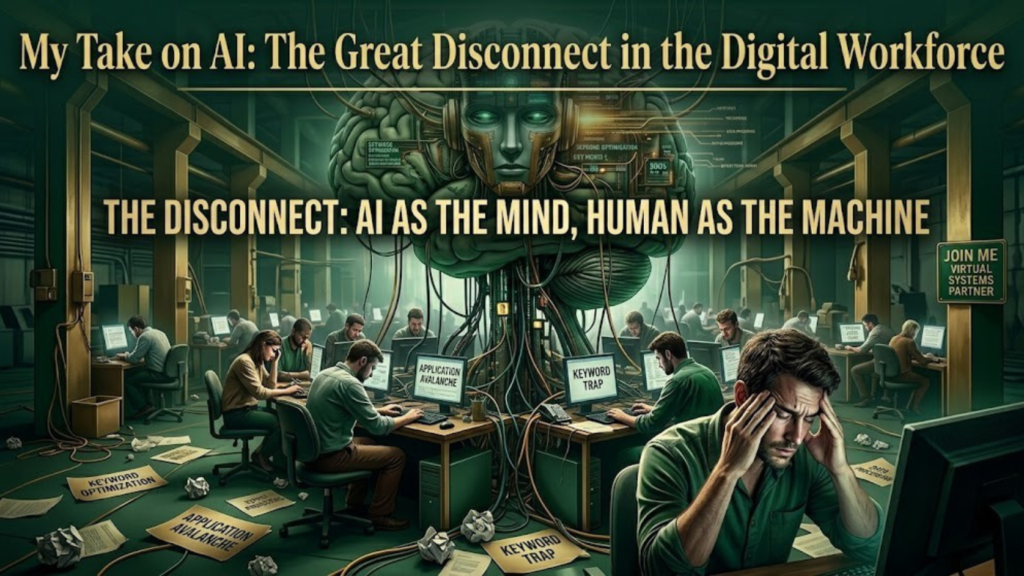
Lately, I’ve been contemplating what is really the effect of AI in terms of the quality of work and the health of every employee now. I came up with these thinking, and while I don’t say everyone, most business owners or companies have fallen into a dangerous rhythm. In a relentless pursuit of hyper-efficiency, the lines of workplace empathy are blurring. We are watching a widespread narrative emerge that treats human professionals as basic operators while positioning software as the true mind of the company. When humanity is stripped from the corporate architecture, the work suffers, and the health of the workforce fractures under a self-manufactured pressure.
The Keyword Trap: How Modern ATS Systems Miss True Talent
The contemporary hiring market is caught in a counterproductive loop. Companies increasingly rely on automated Applicant Tracking Systems (ATS) to filter candidate pools, but this reliance has shifted the baseline from actual capability to precise keyword optimization. A highly qualified specialist—someone with decades of hard-earned operational logic—can easily be bypassed by an algorithm simply because their resume didn’t explicitly repeat a trending phrase.
By prioritizing rigid keyword matching over nuanced professional evaluation, organizations are missing the exact problem-solvers they desperately need. The process has become so mechanical that it screens for compliance rather than competence, leaving true talent stranded outside the gate.
The Application Avalanche: The Backlash of Easy Automation
Technology promised to streamline hiring, but it has inadvertently caused an administrative bottleneck. Because generative tools allow applicants to mass-produce and submit hundreds of tailored resumes with a single click, companies are now completely bombarded with a massive influx of generic applications.
To cope with this avalanche, businesses double down on more automation, implementing automated video screenings, robotic grading systems, and algorithmic filters. The fundamental flaw is that these layers of software do not truly qualify the candidate. They merely measure how well an applicant can navigate an online gatekeeper, creating a sterile, robotic interface that fails to gauge critical thinking, adaptability, or emotional intelligence.
The Absurdity of the Machine-Human Hybrid
This systemic over-reliance on tech has created highly unreasonable expectations in current job listings. It is no longer uncommon to cross paths with postings demanding a single individual to act as a fully qualified software engineer while simultaneously holding an advanced corporate business degree—all for entry-level compensation.
When influencers and leadership hype tools to the point of treating human staff like plug-and-play processors, it fosters a corporate culture that expects machine-like output from human bodies. It is a profound operational error to view human talent as an administrative expense to be minimized, rather than the core strategic engine of the company.
A Wake-Up Call to Freelancers: Stop Under-valuing Your Expertise
But this isn’t just a problem on the corporate side; it is a crisis happening within the freelance and independent contractor community as well. Out of a quiet anxiety surrounding AI, many experienced professionals are panic-pricing their services. We see seasoned experts slashing their rates, bidding on low-ticket tasks out of desperation, and accepting micromanaged, high-stress terms just to secure multiple small projects.
What we must realize is that when you undervalue your expertise, it directly degrades your overall quality of life. You end up working twice the hours for half the pay, sacrificing your peace of mind and accelerating a rapid path toward absolute burnout. Moreover, when experts swoop in to hoard low-budget tasks, they inadvertently take away the vital stepping stones meant for beginners trying to get a foot in the door. It also teaches clients that they can buy premium strategy for pennies. We have a collective responsibility as service providers to lift our standards, stand firm in our worth, and refuse to participate in an unsustainable race to the bottom.
The True Architecture of Scaling: The Mind is Still the Hire
This is exactly why I founded Join Me Virtual. As a Systems Partner with 18 years of specialized operational logic, my perspective on this shift is clear: you do not need a chaotic stack of complex software or an endless web of superficial AI bots to build a resilient, scalable company. Nor should you hand your business strategy over to a probabilistic model.
AI is an exceptional tool for rapid execution, but the mind is still the hire. The real heavy lifting of scaling an organization does not happen because you plugged in a new automated platform; it happens because a human brain stepped in to design the structural logic, untangle the bottlenecks, and plot the clean workflows that simplify operations. At Join Me Virtual, I focus on the structural logic and the underlying architecture so founders don’t have to build on shifting sands. Technology exists to support human capability and create room to breathe, not to replace the critical judgment required to sustain an enterprise long-term.
Moving Beyond the Algorithmic Hype: Manage Expectations, Look for Value
This is an urgent call for business owners, visionary leaders, and elite professionals alike to look past the superficial marketing noise of the software industry. True operational mastery is never about how cleanly you can sweep your payroll or how many human touchpoints you can replace with cold interfaces.
For founders, this requires a fundamental shift in how you manage your team and your expectations:
- Stop hiring for keyword compliance and start looking for deep operational logic.
- Look for actual value and undeniable evidence of work, not just flawless, AI-polished status reports.
- Pay for focused, high-tier expertise rather than demanding five jobs from one exhausted, underpaid contractor who is forced to outsource their attention elsewhere.
Sustainable, scalable growth occurs when you design a clear, high-performing operational engine that respects human capacity, leverages human intellect, and values true specialized expertise. Let us stop following the algorithmic hype and return to building business systems that prioritize clarity, structural integrity, and long-term professional longevity.
Let’s open up a strategic conversation in the comments:
- For the business leaders in my network: Have you noticed a disconnect between what an algorithm considers “qualified” versus the actual human logic needed to run your day-to-day operations?
- For my fellow freelancers and partners: How are you intentionally protecting your baseline value and resisting the pressure to lower your standards in this shifting market?
Let’s discuss below.
To your structural integrity,
Judith Vasquez
Systems Partner & Strategic OBM | Join Me Virtual